

A remix of the Let It Be... Over Already pic from a couple of days ago with all new OLD pics of our federal candidates: Harper, Iggy, Duceppe, and Layton.


How I ripped primetime TV, destroyed US political dreams, and declared my own micronation in 13 minutes. Bring it on world!
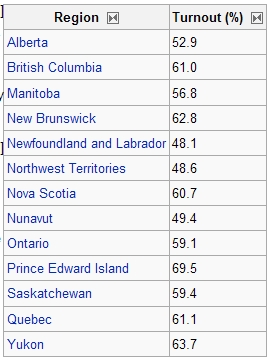
How a party with less than 25% of eligible voters behind them is keeping power from a coalition with 28% of eligible voters behind them. Welcome to my pathetic government.
It's now been about a week since I had to suffer through Wolf Blitzer talking to a fuzzy will.i.am hologram during CNN's election coverage. During the very short snippets I caught, several things became very clear:
1) The next gen. hologram techonology employed by CNN looked like someone didn't how how to set up proper anti-aliasing when creating a mask in Photoshop.
2) That CNN thought ANY member of a pop group, much less the Black-Eyed Peas, deserved any airtime during the so-called "most intriguing election of our time" was yet another example of media gone mental.
3) The "team" of tech wizards at CNN that actually thought it ground-breaking and appealing showing a fuzzy 3D hologram of a person that we were watching on a 2D medium need their heads examined by a doctor around the world using the same fuzzy holographic technology.
How different is this from the days we used to make fun of television ads that asked "does your TV look this good?"
Gizmodo.com outlined the laundry list of technology that was necessary to have this groundbreaking effort brought to my screen.
• 35 HD cameras pointed at the subject in a ring
• Different cameras shoot at different angles (like the matrix), to transmit the entire body image
• The cameras are hooked up to the cameras in home base in NY, synchronizing the angles so perspective is right
• The system is set up in trailers outside Obama and McCain HQ
• Not only is it mechanical tracking via camera communication, there's infrared as well
• Correspondents see a 37-inch plasma where the return feed of the combined images are fed back to them. Useful for a misplaced hair or an unseemly boogar
• Twenty "computers" are crunching this data in order to make it usable.
The sad reality of the end result of this endeavor is that the subjects would have looked far better using just ONE HD camera and putting up a split screen. These people have never looked so bad on television. Until they can figure out a way to get the hologram into my rec room, the technology as used on TV is useless.
Yet, all this said, I admire that the network is at least thinking of pushing the envelope. This idea was truly noble in conception if not in execution. After all how many ways can a screen be broken up to accommodate a dozen or more pundits? How many more touchscreens or crazy new-fangled telestrator technologies must we be subjected to so that the sidekick, young "hip" analyst can drag and drop so many objects and statistics around like a green screen weather man with a god complex?
I have, on many occasions, wished for advancements in holographic technology like the kind we were poorly exposed to on CNN. The advancements, however, need to happen at the end-user level before there is any purpose in integrating such technology into broadcasting. Give me a home unit that can do simple stuff like show 3D maps, animation, or simple content that will prove the medium as a useful home entertainment device.
To sum up the pros and cons of cable news and its continuing efforts with next gen technology:
Pro - Wanting to push the envelope is never bad.
Con - 3DTV is the next frontier and after that holographics is really NEXT next gen, let's at least get the order right.
Con - Selling any program, much less election coverage, on a half-assed, poorly-executed concept is beyond lame.
It's not just a CNN problem. Instead, networks need to stop hiding their ineptitude behind fancy graphics and "cutting edge" wishlist technology and providing real reporting, inciteful commentary and content that transcends personality, graphics and glitz. Don't get me wrong, I love the idea of home holographic technology on the horizon, but I hate that persistent weak attempts at such advancements may do more to discourage development instead of enhance it.

Concerning compulsive event-based tweeting, funny squares, and loving concrete.

Really? No, I'm seriously sitting in awe here.
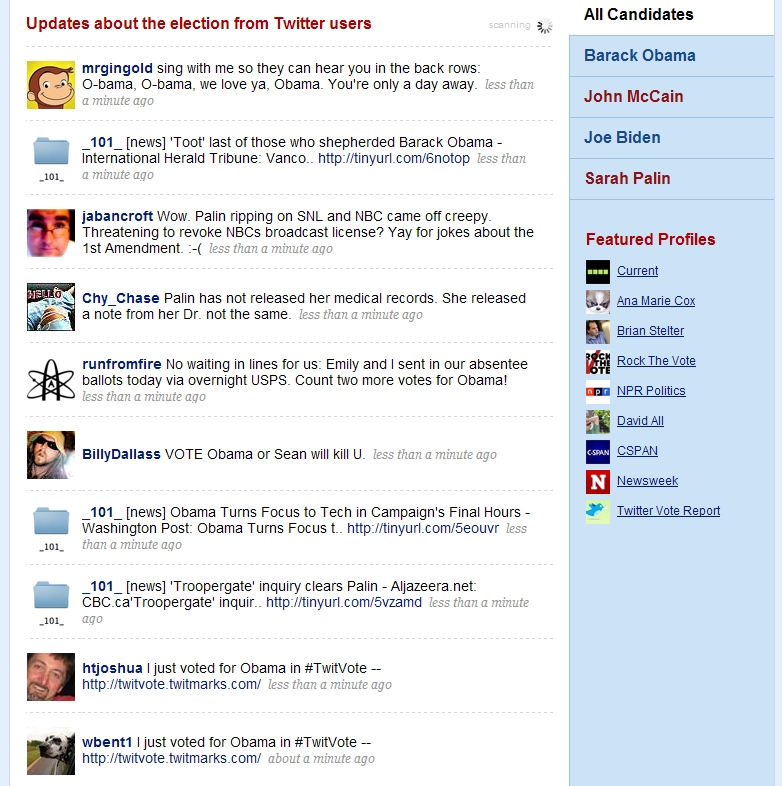
I get that people are pumped up for this US election, and while I swore I wouldn't do another lovehate rant on elections, this is not so much on the elections as what people are doing while the election is happening: twittering... REALLY?
Are we so starved for social intercourse that we are willing to snippet snipe about red state/blue state maps and exit polls? Sure there's reason for commentary about several things to do with an election. Discuss the results and potential impact of how the country has once again been split down the middle and wax electoral about policy shifts and the economy. Engage in dialectic and diatribe about how pundits and media have sullied the political process. Deride Wolf Blitzer, Sean Hannity and Keith Olbermann. Criticize the networks for declaring winners based on exit polls before everyone has even voted. Type insight. Type observation. Be bold and above all, complete your thoughts, because while I encourage all bloggers to express themselves, I wish they would do so with well-developed ideas that went on for longer than 140 characters.
While I obviously have an affection for Twitter, and appreciate the role microblogging has occupied in the social networking community, I can honestly not think of one of the many great people I follow that would prompt me to spend the night in front of a browser window watching pithy comments like "Wow, how about that Ohio map!" I'm more interested in hearing about what Ramen noodle seasoning people are using while channel surfing.
All respect to the power bloggers and Web 2.0 gurus who's followers will hang on every word of their Twitter, Laconi.ca, Plurk, or Pownce election coverage. If you've got followers that want to know what you think on a minute by minute basis, you've done a hell of a job in consolidating a loyal following who will hang on your every word. and, for bloggers, followers are currency. You've established a community that hears your opinions on tech or media or gadgets and integrates your subjectivity into their own. Kudos for that. I would have it no other way. I don't have time to keep up on every new media advancement and I heartily appreciate the podcasters and bloggers that parse down daily and weekly events in tech for me in compartmentalized segments.
Am I really missing the boat on the online ocean that makes it hip to engage in blurb ineractions about something that, by sitting in front of your computer, you're doing less to participate in than a person standing in line with their registration card? I honestly don't begrudge someone who gets a kick out of spending their election night (or any night for that matter) lost in a sea of millions of tweets if they honestly get a kick out of such things. Really, you could be doing far worse things like... oh, I don't know... watching network coverage of the election with pundits in formation like a line up of gargoyles sitting behind a desk that looks like it came off of page 63 of the Ikea catalogue.
If you really look forward to being part of tweet ocean during a big event. Have at it. Curse my idiocy and create yourself a special avatar for the night. But, if you're like me, who generally respects the input of the people whose tweets you follow, ignore the flood of shock and blah that accompanies the event. Take two shots of NyQuil, pop on a live version of Mandrake Root by Deep Purple, and wake up in the morning where the results of what happened the night before will not have changed... actually, just go to election.twitter.com and watch it for ten minutes - you'll achieve the same effect as the drugs and the music.
My satirical interpretation of regional legislative voting campaigns.